
Scenario & Challenges
The customer has more than twenty production bases worldwide with massive daily output. The quality inspection process has long faced group-level management and efficiency bottlenecks. Traditional manual visual inspection is not only inefficient and inconsistent, making it difficult to keep up with production line pace, but inspection standards also vary across factories, causing quality fluctuation risks to accumulate continuously.
Uploading all quality inspection data to a central cloud for AI inference would enable centralized management, but it faces multiple obstacles: millisecond-level real-time performance cannot be guaranteed, factory network bandwidth is under enormous pressure, and data transmission conflicts with privacy compliance requirements. Individual factories had previously tried deploying edge servers independently, but the lack of top-level planning created serious compute silos: mixed hardware models, chaotic model versions, and fragmented O&M. Overall resource utilization was below 30%, while management costs multiplied. More critically, strict industry regulations require core production data to remain within the factory premises and prohibit cross-campus data flow.
What the customer urgently needs is not just an upgrade of individual inspection tools, but a standardized, sustainable, and evolvable edge inference infrastructure for multiple factories—one that can be centrally managed, elastically scaled, and support a broader range of edge intelligence scenarios beyond quality inspection.
Implementation Approach
Facing this complex group-level challenge, the integrated edge intelligence infrastructure plan extends from architecture design to deployment and O&M. The core approach is as follows:
1. Globally distributed edge inference node layout
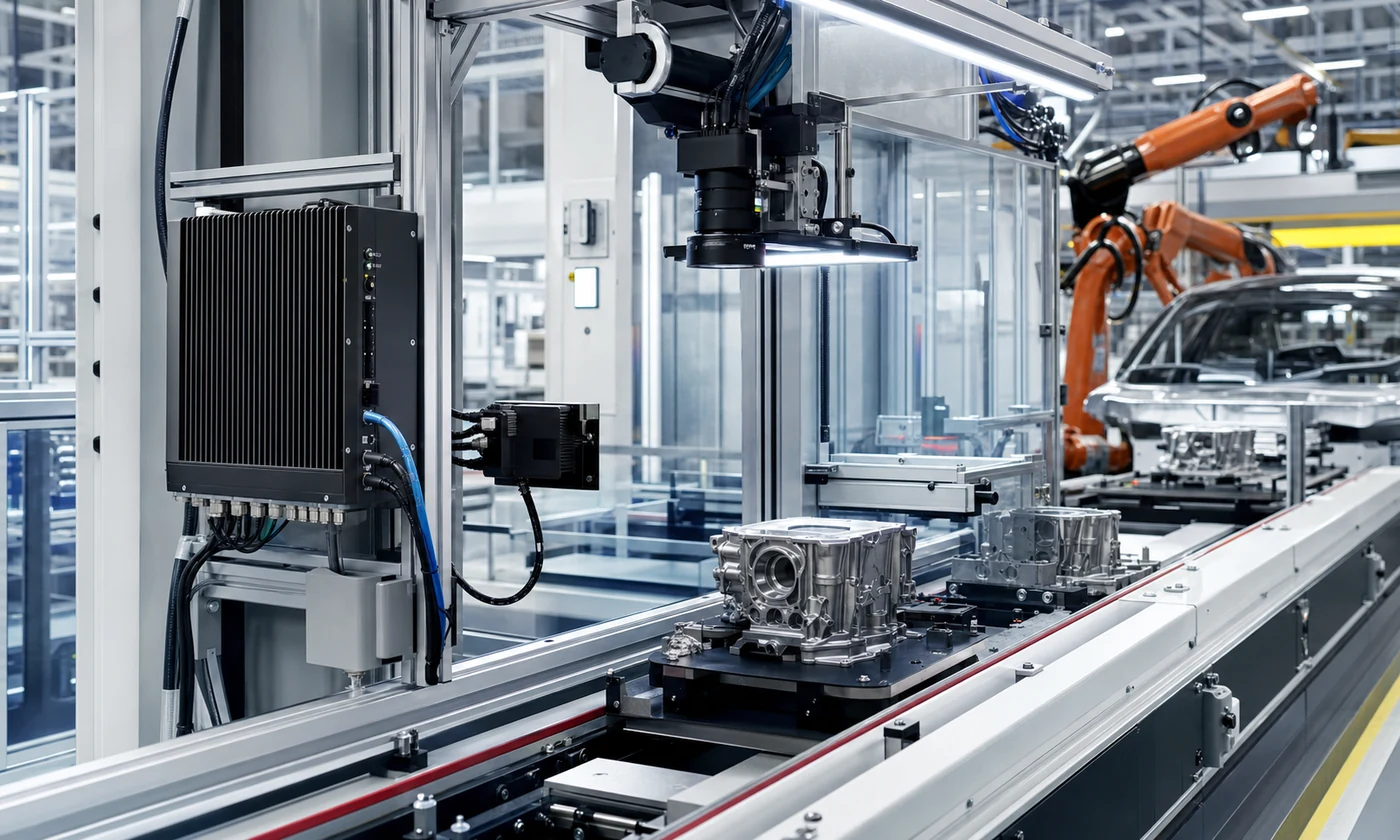
Based on production line pace, inspection point density, and model complexity, high-performance edge server clusters are planned on the production line side of each factory to form local inference units. Nodes are connected close to industrial cameras and sensors to ensure millisecond-level real-time response. Redundancy design and load balancing mechanisms ensure uninterrupted production line operation.
2. Unified central management platform and model governance
A group-level central management plane is established to manage the full lifecycle of edge nodes across all factories. It enables unified storage of the model repository, one-click batch distribution, version rollback, and canary upgrades. No matter where a factory is located, algorithm iteration strategies are centrally formulated by headquarters, completely eliminating the situation where each factory manages its own system.
3. Pooling and dynamic scheduling of heterogeneous compute resources
The edge server plan supports mixed installation of multiple AI accelerator cards. Through virtualization and container technologies, heterogeneous compute resources such as CPU, GPU, and NPU are abstracted into a unified resource pool. The platform automatically and elastically allocates compute resources according to workload changes across different production lines and models, ensuring timely support for inference tasks during night shifts or peak periods, while idle resources are automatically released for reuse by other intelligent applications.
4. Security compliance and industrial-grade network planning
A low-latency industrial network is designed to ensure real-time interconnection between edge nodes and field devices, while strict security boundaries are established to keep data within the campus and meet compliance requirements. Connections to the central platform use encrypted dedicated lines with separation of management channels, balancing security and manageability.
5. Future-oriented elastic infrastructure architecture
From the initial design, the overall architecture reserves sufficient compute expansion slots, high-speed network interfaces, and modular node onboarding mechanisms. It not only meets current quality inspection scenarios but can also smoothly support future edge intelligence applications such as personnel safety behavior analysis, predictive equipment maintenance, and digital twins, fully protecting the customer's long-term strategic investment.
Results
With this edge intelligence infrastructure plan, the customer successfully completed a comprehensive transformation from traditional manual quality inspection to AI-driven intelligent quality inspection across multiple factories. Quality inspection inference for all factories in the group now runs uniformly on the planned infrastructure, and the time to launch a quality inspection system for a new factory has been reduced from months to less than two weeks.
Model updates have changed from "each factory scheduling separately, taking days" to "headquarters synchronizing with one click, taking effect globally within hours." Edge inference latency is stably controlled within production line pace requirements, with zero missed-detection or line-stoppage incidents caused by compute power or latency issues. Overall compute resource utilization has jumped from below 30% to over 70%. Under equivalent capacity expansion, this has significantly saved duplicate hardware investment and power consumption, and O&M personnel no longer need to "fight fires" across workshops.
Most importantly, this standardized and replicable edge inference foundation has not only reduced product defect miss rates to the lowest level in history, but also easily supports multiple new intelligent scenarios such as personnel safety monitoring and equipment anomaly warning. Customer management evaluated it as "a key infrastructure foundation for moving toward full-factory digital and intelligent transformation." The successful implementation of this plan fully demonstrates the feasibility and value of solving multi-factory edge intelligence challenges from a holistic infrastructure perspective, and sets a benchmark for large-scale intelligent upgrades of more manufacturing customers.